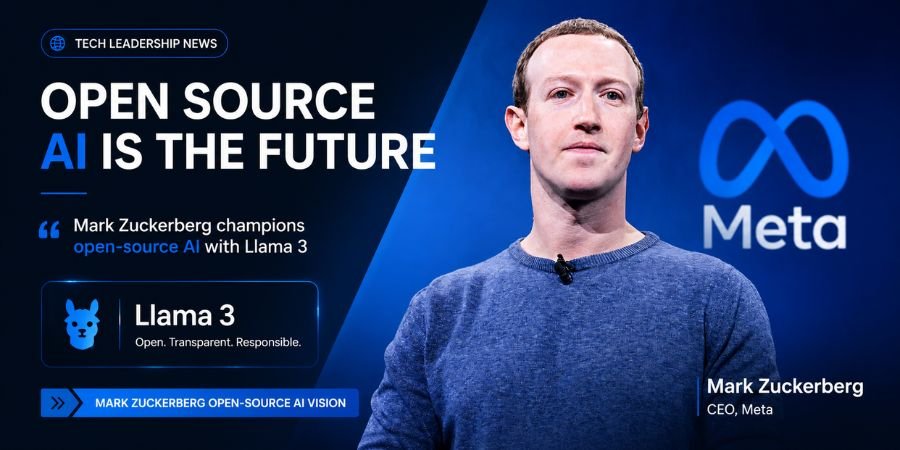
Mark Zuckerberg is intensifying his campaign for open-source artificial intelligence, positioning Meta’s Llama 3 models as a more transparent and responsible alternative to closed AI systems developed by major competitors. The move is rapidly gaining attention across the global tech industry as businesses, developers, and AI researchers debate the future direction of artificial intelligence innovation.
The billionaire tech executive has repeatedly argued that open-source AI encourages faster innovation, stronger security testing, and broader accessibility. By making powerful AI models available to developers worldwide, Meta aims to create an ecosystem where companies can build AI products more freely without depending on tightly controlled proprietary systems.
Why Mark Zuckerberg’s AI Strategy Is Trending
The Mark Zuckerberg Open-Source AI Vision is trending because it directly challenges the dominant business models of several leading AI companies. While many competitors keep their most advanced AI systems closed and restricted, Meta is taking the opposite approach by promoting openness and collaboration.
Industry analysts believe Zuckerberg’s strategy could influence how future AI regulations are shaped globally. Governments and technology leaders are increasingly discussing AI transparency, accountability, and ethical development, making Meta’s approach a major talking point in the sector.
The launch and promotion of Llama 3 have also intensified competition in the AI race. Developers are showing growing interest in customizable and accessible AI systems that can be adapted for business, education, healthcare, and research applications.
Llama 3 Becomes Central to Meta’s AI Expansion
Meta has positioned Llama 3 as a cornerstone of its long-term AI ambitions. The company believes open-source development can accelerate breakthroughs by allowing independent researchers and organizations to contribute improvements and identify risks faster.
Supporters of open-source AI argue that wider access reduces the concentration of power among a small number of tech giants. They also claim that transparency can improve trust in AI systems, especially as concerns grow over misinformation, bias, and data privacy.
However, critics warn that openly available advanced AI models could also create new security challenges if misused. This debate has become one of the defining issues shaping the future of artificial intelligence.
Tech Industry Divided Over Open vs Closed AI Models
The growing discussion around the Mark Zuckerberg Open-Source AI Vision reflects a broader divide within the technology industry. Some companies prioritize controlled ecosystems to maintain safety and commercial advantage, while others believe openness drives innovation at a faster pace.
Zuckerberg has consistently emphasized that open-source platforms historically played a major role in the growth of the internet and modern software development. By applying the same philosophy to AI, Meta hopes to establish itself as a leading force in the next phase of technological transformation.
The strategy is also helping Meta strengthen its position in the increasingly competitive AI market, where companies are racing to attract developers, enterprise clients, and global partnerships.
What Comes Next for Open-Source AI?
As the AI industry evolves, the success of Meta’s open-source strategy could influence how future AI platforms are developed and regulated worldwide. If Llama 3 continues gaining momentum, more companies may adopt hybrid or open AI approaches to remain competitive.
With the global debate over AI transparency growing stronger, the coming months could determine whether open-source models become the dominant path forward or remain a contested alternative in the rapidly expanding AI landscape.
Also Read: Bernard Arnault LVMH Asia Strategy: Seoul Visit Sparks Buzz