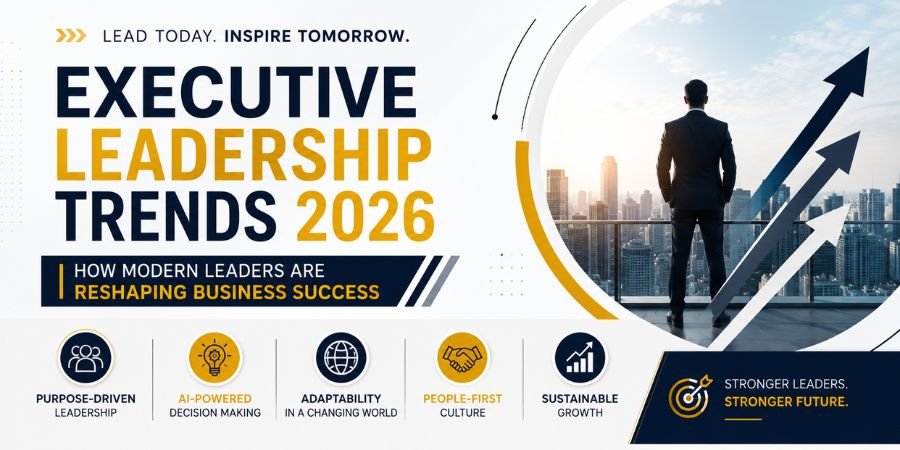
Leadership inside modern organizations no longer looks the way it did even five years ago. Executives today are managing hybrid workforces, rapid technological disruption, employee burnout, economic uncertainty, and shifting customer expectations all at once. Companies that once relied on rigid management structures are now prioritizing adaptability, emotional intelligence, digital transformation, and long-term strategic thinking. These changes are why executive leadership trends have become one of the most important business conversations heading into 2026.
The pressure on executives has intensified dramatically. Leaders are expected to make faster decisions, inspire innovation, protect company culture, embrace AI responsibly, and still deliver measurable financial results. At the same time, employees want more transparency, flexibility, and purpose-driven leadership than ever before. Organizations that fail to adapt are struggling to retain talent, maintain productivity, and compete effectively in increasingly unpredictable markets.
The most successful executive leaders are not simply managing operations anymore. They are building resilient ecosystems, empowering teams, and creating organizations capable of evolving continuously. Understanding these shifts is critical not only for CEOs and senior executives but also for entrepreneurs, startup founders, managers, consultants, and future business leaders preparing for long-term growth.
This guide explores the most important executive leadership trends shaping 2026, explains why they matter, and provides practical insights businesses can apply immediately.
Why Executive Leadership Is Changing So Rapidly
Executive leadership has entered a period of accelerated transformation. Several global forces are reshaping how organizations operate and how leaders must respond.
Technology is evolving faster than traditional business systems can adapt. Artificial intelligence, automation, and predictive analytics are changing workflows, hiring, customer service, and strategic planning. Executives are expected to understand these tools while balancing innovation with ethical responsibility.
At the same time, workforce expectations have shifted dramatically. Employees increasingly value flexibility, mental wellness, meaningful work, and professional growth. Traditional command-and-control leadership styles are becoming less effective in modern environments where collaboration and trust matter more than hierarchy.
Economic uncertainty also plays a major role. Inflation concerns, global competition, supply chain disruptions, and market volatility require leaders to think strategically while remaining agile. Long-term planning now depends on adaptability as much as forecasting.
Another major factor is information overload. Leaders today receive enormous amounts of data daily. The challenge is no longer finding information but identifying what truly matters and making smart decisions quickly.
These pressures have created a new generation of executive leadership trends focused on resilience, adaptability, emotional intelligence, and digital readiness.
The Rise of Human-Centered Leadership
One of the strongest executive leadership trends in 2026 is the shift toward human-centered leadership. Employees no longer want leaders who simply issue instructions and monitor performance. They want leaders who understand people, communicate clearly, and build environments where teams can thrive.
Human-centered leadership focuses on empathy, listening, transparency, and trust. Organizations that adopt this approach often see higher retention, stronger collaboration, and better long-term productivity.
Why Emotional Intelligence Matters More Than Ever
Technical expertise still matters, but emotional intelligence has become equally important. Executives who can manage relationships, understand team dynamics, and respond calmly under pressure tend to build stronger organizations.
Leaders with high emotional intelligence often excel at:
- Conflict resolution
- Employee motivation
- Cross-functional collaboration
- Crisis management
- Organizational communication
- Team engagement
For example, during periods of organizational restructuring, emotionally intelligent leaders communicate honestly while maintaining employee confidence. This reduces uncertainty and improves morale.
Companies are increasingly assessing emotional intelligence during executive hiring processes because leadership effectiveness now depends heavily on interpersonal capabilities.
Building Psychological Safety in Teams
Modern executives are prioritizing psychological safety, where employees feel comfortable sharing ideas, concerns, and feedback without fear of punishment.
Innovation thrives in environments where people can speak openly. Leaders who encourage constructive disagreement and diverse perspectives often make better strategic decisions.
Google’s long-running workplace research consistently found psychological safety to be one of the most important characteristics of high-performing teams. This insight continues influencing leadership strategies across industries.
Executives are learning that creating a culture of openness is not a soft skill. It is a competitive advantage.
AI-Driven Decision Making Is Reshaping Leadership
Artificial intelligence is transforming executive leadership at nearly every level. Leaders are increasingly using AI tools for forecasting, customer analysis, operational efficiency, and strategic planning.
However, the biggest shift is not automation itself. It is how executives integrate AI into decision-making processes without losing human judgment.
Data-Driven Leadership Is Becoming Standard
Modern leaders now rely heavily on real-time analytics to guide decisions. Executive dashboards, predictive models, and AI-generated insights allow organizations to identify opportunities and risks much faster than before.
Executives use data to improve:
- Hiring decisions
- Customer targeting
- Budget forecasting
- Market analysis
- Operational efficiency
- Productivity tracking
The most effective leaders combine data insights with practical business experience rather than relying solely on algorithms.
For example, an AI model may predict declining customer engagement, but experienced executives still need to interpret why it is happening and determine the best strategic response.
Ethical AI Leadership Is Emerging as a Priority
As organizations rely more on AI systems, ethical leadership becomes increasingly important.
Executives must address concerns related to:
- Data privacy
- Algorithmic bias
- Workplace automation
- Transparency
- Responsible AI usage
Consumers and employees are paying closer attention to how businesses use technology. Companies that ignore ethical considerations risk reputational damage and regulatory scrutiny.
Forward-thinking executives are creating AI governance frameworks that balance innovation with accountability.
Hybrid Work Leadership Is Becoming a Permanent Skill
Remote and hybrid work are no longer temporary trends. They have become foundational parts of modern business operations.
One of the biggest executive leadership trends in 2026 is mastering distributed workforce management.
Leaders can no longer depend on physical presence to measure productivity or build culture. Instead, they must focus on communication, outcomes, and trust.
Managing Performance in Hybrid Teams
Successful hybrid leadership requires clarity and structure.
Executives are redesigning workflows around measurable outcomes instead of time spent in offices. High-performing organizations often establish:
- Clear communication systems
- Defined performance metrics
- Flexible collaboration tools
- Regular check-ins
- Strong documentation practices
Leaders who micromanage remote teams usually create frustration and lower engagement. Modern leadership emphasizes autonomy combined with accountability.
Rebuilding Company Culture in Digital Environments
One major challenge with hybrid work is maintaining organizational culture.
Executives are investing heavily in digital engagement strategies, including:
- Virtual team-building
- Online leadership communication
- Employee wellness initiatives
- Cross-department collaboration programs
- Digital recognition systems
Strong culture now depends more on leadership consistency than physical office spaces.
Organizations that succeed in hybrid environments typically have leaders who communicate vision clearly and reinforce shared values regularly.
Purpose-Driven Leadership Is Influencing Business Strategy
Another major executive leadership trend is the rise of purpose-driven organizations.
Employees and consumers increasingly expect businesses to stand for something beyond profit alone. Leaders are under pressure to demonstrate social responsibility, sustainability, and ethical business practices.
Why Purpose Matters to Modern Employees
Younger professionals especially want meaningful work environments. They prefer organizations aligned with values such as:
- Sustainability
- Diversity and inclusion
- Community impact
- Ethical sourcing
- Transparency
- Employee wellbeing
Executives who ignore these expectations may struggle with recruitment and retention.
Purpose-driven leadership helps organizations create stronger emotional connections with both employees and customers.
Balancing Profitability With Social Responsibility
Successful leaders understand that purpose and profitability are not opposites.
For example, companies investing in sustainability often reduce operational waste, improve brand reputation, and attract long-term customers.
Executives are increasingly integrating environmental, social, and governance goals into broader business strategies.
This does not mean every company must become activist-driven. Instead, it means leaders should understand how business decisions impact employees, customers, communities, and long-term organizational trust.
Adaptive Leadership Is Replacing Rigid Management Models
Traditional leadership models focused heavily on stability, predictability, and control. In contrast, modern organizations require adaptability.
Adaptive leadership is one of the defining executive leadership trends because markets now change too quickly for rigid systems.
Leaders Must Become Continuous Learners
Executives can no longer rely solely on past experience. Industries evolve rapidly, and leadership strategies that worked previously may become ineffective.
Modern leaders prioritize continuous learning through:
- Executive coaching
- Industry research
- Leadership development programs
- Peer networking
- Technology education
- Market trend analysis
Organizations increasingly value leaders who can evolve alongside changing business environments.
Agility Is Becoming a Competitive Advantage
Adaptive leaders respond faster to disruptions because they encourage experimentation and decentralized decision-making.
For example, during economic uncertainty, agile organizations often adjust pricing, operations, or marketing strategies more quickly than competitors.
Executives who embrace adaptability build businesses capable of surviving long-term volatility.
Diversity and Inclusive Leadership Are Driving Innovation
Diversity initiatives are evolving beyond compliance requirements. Modern executives increasingly recognize diversity as a strategic advantage.
Inclusive leadership helps organizations improve creativity, decision-making, and market understanding.
Diverse Teams Often Produce Better Results
Research consistently shows that diverse teams can outperform homogeneous groups in problem-solving and innovation.
Organizations with inclusive leadership often benefit from:
- Wider market perspectives
- Better customer understanding
- Improved creativity
- Reduced groupthink
- Stronger employer branding
Executives are increasingly focusing on building leadership pipelines that reflect broader workforce diversity.
Inclusive Communication Is Becoming Essential
Inclusive leadership goes beyond hiring practices. It involves creating environments where different voices are genuinely valued.
Executives are learning to:
- Encourage diverse perspectives
- Address unconscious bias
- Improve accessibility
- Foster equitable opportunities
- Support inclusive collaboration
This shift improves both organizational culture and business performance.
The Growing Importance of Leadership Transparency
Trust has become one of the most valuable assets in modern organizations.
Employees want honest communication about business goals, challenges, and expectations. Investors also increasingly expect transparency regarding operations and governance.
Transparent Communication Builds Stability
Executives who communicate openly during uncertain periods often maintain stronger employee confidence.
Transparent leadership includes:
- Sharing strategic direction
- Explaining major decisions
- Acknowledging challenges honestly
- Providing regular updates
- Encouraging employee feedback
Organizations with strong communication cultures generally experience lower internal confusion and higher engagement.
Authenticity Matters More Than Perfection
Employees no longer expect executives to appear flawless. Instead, they value authenticity and accountability.
Leaders who admit mistakes and demonstrate learning often build stronger credibility than those who attempt to project constant certainty.
This shift represents a significant cultural change in executive leadership.
Digital Transformation Leadership Is Now Essential
Digital transformation is no longer limited to technology companies. Businesses across nearly every industry are modernizing operations through automation, analytics, cloud systems, and AI.
Executives must now lead technological change while maintaining operational stability.
Technology Leadership Requires Business Understanding
The best digital leaders understand both technology and business strategy.
Executives do not necessarily need deep technical expertise, but they must understand how digital tools affect:
- Customer experience
- Productivity
- Revenue growth
- Operational efficiency
- Market competitiveness
Leaders who ignore digital transformation risk falling behind more agile competitors.
Change Management Is Critical
Technology implementation often fails because of poor leadership rather than poor software.
Successful executives focus heavily on:
- Employee training
- Internal communication
- Change adoption
- Clear implementation goals
- Cross-functional alignment
Digital transformation succeeds when leaders help employees understand the purpose behind organizational changes.
Wellness-Focused Leadership Is Becoming Mainstream
Burnout has become a major organizational challenge. High workloads, economic stress, and constant digital connectivity have significantly impacted employee wellbeing.
As a result, wellness-focused leadership is emerging as a major trend.
Mental Health Is Now a Leadership Responsibility
Modern executives increasingly recognize that employee wellbeing directly affects productivity, retention, and organizational performance.
Companies are investing in:
- Flexible schedules
- Mental health resources
- Wellness programs
- Burnout prevention strategies
- Health-focused workplace policies
Leaders who ignore employee wellbeing often experience higher turnover and lower morale.
Sustainable Productivity Is Replacing Hustle Culture
The traditional “always-on” executive mindset is losing popularity.
Organizations are realizing that sustainable performance depends on balanced workloads and healthy workplace practices.
Executives are now more likely to encourage recovery, focus, and long-term effectiveness rather than glorifying exhaustion.
Strategic Storytelling Is Becoming a Leadership Skill
One of the more overlooked executive leadership trends is the growing importance of storytelling.
Executives must communicate complex ideas clearly across employees, investors, customers, and stakeholders.
Leaders Need Clear Narratives
Strong leadership communication helps organizations align around shared goals.
Executives increasingly use storytelling to:
- Explain strategic vision
- Inspire teams
- Navigate change
- Build customer trust
- Strengthen company identity
Facts alone rarely motivate people. Stories create emotional connection and organizational momentum.
Communication Is Now Constant
Modern leaders operate in environments where communication happens continuously across digital platforms, meetings, internal channels, and public media.
Executives who communicate clearly and consistently often build stronger organizational alignment.
Cybersecurity Awareness Is Becoming a Leadership Priority
Cybersecurity is no longer only an IT issue. It has become a leadership issue.
Executives must now understand digital risk management because cyber incidents can damage finances, operations, and brand trust.
Leaders Must Understand Cyber Risk
Modern executive leadership includes awareness of:
- Data protection
- Cybersecurity infrastructure
- Regulatory compliance
- Digital privacy
- Crisis response planning
Organizations increasingly include cybersecurity discussions at the executive and board level.
Crisis Preparedness Is Essential
Executives are expected to lead effectively during digital crises.
Preparation includes:
- Response protocols
- Communication strategies
- Business continuity planning
- Security training
- Vendor risk assessment
Leadership readiness can significantly reduce damage during cybersecurity incidents.
Generational Leadership Dynamics Are Changing Workplaces
Modern organizations often include employees from multiple generations working together simultaneously.
This creates both opportunities and leadership challenges.
Different Generations Have Different Expectations
Younger professionals often prioritize flexibility, growth, and purpose-driven work, while older employees may emphasize stability and institutional knowledge.
Executives must balance these varying expectations while maintaining organizational cohesion.
Reverse Mentorship Is Growing
Many companies are embracing reverse mentorship programs where younger employees help senior leaders understand emerging technologies, digital behavior, and changing consumer trends.
This trend improves collaboration and reduces generational disconnects.
Practical Examples of Executive Leadership Trends in Action
Understanding trends is important, but practical application matters even more. Here are several real-world leadership scenarios demonstrating how modern executives are adapting.
Example 1: Hybrid Workforce Transformation
A mid-sized software company struggled with declining morale after shifting to remote work. Employees felt disconnected, and collaboration weakened.
The executive team implemented several changes:
- Weekly leadership town halls
- Flexible scheduling
- Project-based performance metrics
- Virtual mentorship programs
- Cross-team collaboration systems
Within one year, employee retention improved significantly, and project delivery became more efficient.
The key lesson was that hybrid work success depends on intentional leadership systems rather than simply allowing remote access.
Example 2: AI-Powered Decision Making
A retail company used AI analytics to identify changing customer purchasing patterns.
Instead of relying solely on historical sales reports, executives began using predictive forecasting tools to adjust inventory and marketing strategies in real time.
This allowed the business to reduce waste, improve customer targeting, and increase profitability.
However, leadership still relied on human oversight to evaluate broader market conditions and customer sentiment.
Example 3: Wellness-Centered Leadership
A consulting firm experienced high employee burnout due to excessive workloads.
Executives introduced:
- Mandatory vacation policies
- Reduced after-hours communication
- Mental health resources
- Workload balancing systems
- Flexible project scheduling
Productivity improved because employees became more focused and engaged.
This example highlights how sustainable leadership often produces stronger long-term performance than aggressive hustle culture.
Common Leadership Mistakes Executives Must Avoid
Even experienced leaders can struggle during periods of transformation.
Understanding common mistakes helps organizations avoid unnecessary setbacks.
Ignoring Employee Feedback
Executives who fail to listen to employees often lose touch with operational realities.
Frontline teams frequently identify problems and opportunities before leadership does.
Organizations benefit when executives create genuine feedback channels.
Over-Reliance on Technology
Technology can improve efficiency, but leadership still requires human judgment.
Executives who rely entirely on metrics or automation may overlook cultural issues, customer relationships, and strategic nuance.
Poor Communication During Change
Unclear communication creates uncertainty and resistance.
Executives should explain not only what is changing but also why it matters and how employees will be supported.
Focusing Only on Short-Term Results
Short-term performance matters, but organizations also need long-term resilience.
Leaders who prioritize quarterly gains while neglecting culture, innovation, or employee development often create future instability.
Resisting Adaptation
Executives who cling to outdated leadership models may struggle in rapidly evolving industries.
Adaptability is now one of the most valuable leadership traits.
How Future Executives Can Prepare for Leadership Roles
Leadership development is changing alongside broader business trends.
Aspiring executives should focus on building both technical and interpersonal capabilities.
Develop Strategic Thinking Skills
Future leaders must understand:
- Market dynamics
- Financial decision-making
- Organizational behavior
- Technology trends
- Competitive strategy
Strategic thinking helps leaders make informed long-term decisions.
Build Communication and Relationship Skills
Strong leadership depends heavily on communication.
Aspiring executives should practice:
- Public speaking
- Conflict management
- Team collaboration
- Negotiation
- Active listening
These skills become increasingly valuable at senior leadership levels.
Stay Digitally Informed
Executives do not need to become software engineers, but they should understand emerging technologies and their business implications.
Digital literacy is becoming essential for modern leadership.
Learn to Manage Uncertainty
Future business environments will likely remain unpredictable.
Leaders who can remain calm, adaptable, and solution-focused during uncertainty will have major advantages.
Executive Leadership Trends and Entrepreneurship
Executive leadership trends are not limited to large corporations. Entrepreneurs and startup founders are also applying these principles to build scalable businesses.
Startup Leaders Are Prioritizing Culture Earlier
Many startups now focus on company culture from the beginning instead of waiting until expansion stages.
Founders understand that culture strongly influences hiring, retention, and brand reputation.
Small Businesses Are Embracing Digital Leadership
Even smaller companies are adopting tools such as:
- AI-powered customer support
- Cloud collaboration systems
- Digital marketing analytics
- Remote workforce management platforms
Leadership today increasingly involves understanding technology regardless of company size.
Entrepreneurial Leadership Requires Flexibility
Startup founders often operate in highly uncertain environments.
The ability to adapt quickly, communicate vision clearly, and build resilient teams aligns closely with broader executive leadership trends.
The Future Outlook for Executive Leadership Beyond 2026
The pace of business transformation is unlikely to slow down. Future leadership will probably become even more connected to technology, ethics, adaptability, and human-centered management.
Several trends are likely to expand further:
- AI-assisted leadership systems
- Skills-based workforce models
- Flexible organizational structures
- Sustainability-driven business strategies
- Global digital collaboration
- Leadership personalization through analytics
At the same time, timeless leadership qualities will remain essential.
Integrity, trust, resilience, strategic thinking, and emotional intelligence will continue defining successful executives regardless of technological advancement.
The leaders who thrive in future business environments will not necessarily be those with the loudest authority or the most rigid control systems. They will be the leaders capable of learning continuously, adapting intelligently, and building organizations where people can perform at their best.
Frequently Asked Questions About Executive Leadership Trends
What are the biggest executive leadership trends in 2026?
The biggest executive leadership trends include AI-driven decision-making, hybrid workforce management, human-centered leadership, digital transformation, wellness-focused leadership, and adaptive organizational strategies.
Why is emotional intelligence important for executives?
Emotional intelligence helps executives manage relationships, communicate effectively, resolve conflicts, and build trust within organizations. It has become increasingly important in collaborative and hybrid work environments.
How is AI changing executive leadership?
AI helps leaders analyze data, improve forecasting, automate processes, and make faster decisions. However, executives still need human judgment to evaluate strategy, ethics, and organizational impact.
What is human-centered leadership?
Human-centered leadership focuses on empathy, communication, employee wellbeing, collaboration, and trust. It prioritizes people alongside performance and profitability.
How can future leaders prepare for changing leadership trends?
Future leaders should develop strategic thinking, emotional intelligence, communication skills, digital literacy, adaptability, and continuous learning habits to remain effective in evolving business environments.
Final Thoughts on Executive Leadership Trends
The evolution of executive leadership reflects broader changes happening across business, technology, and society. Organizations no longer succeed through authority alone. They succeed through adaptability, trust, innovation, and strong human connection.
Modern executives are expected to balance technological advancement with ethical responsibility, operational performance with employee wellbeing, and strategic growth with organizational resilience. This balancing act is becoming one of the defining challenges of leadership in 2026.
Businesses that embrace these executive leadership trends early are positioning themselves for stronger long-term growth, healthier workplace cultures, and greater competitive advantage. Those that resist change may struggle to attract talent, maintain innovation, and navigate increasing complexity.
Leadership today is less about controlling systems and more about enabling people, guiding transformation, and building organizations capable of thriving through uncertainty. That shift is not temporary. It is shaping the future of business itself.
Also Read: Visionary CEOs 2026: How Modern Leaders Are Redefining Business Success