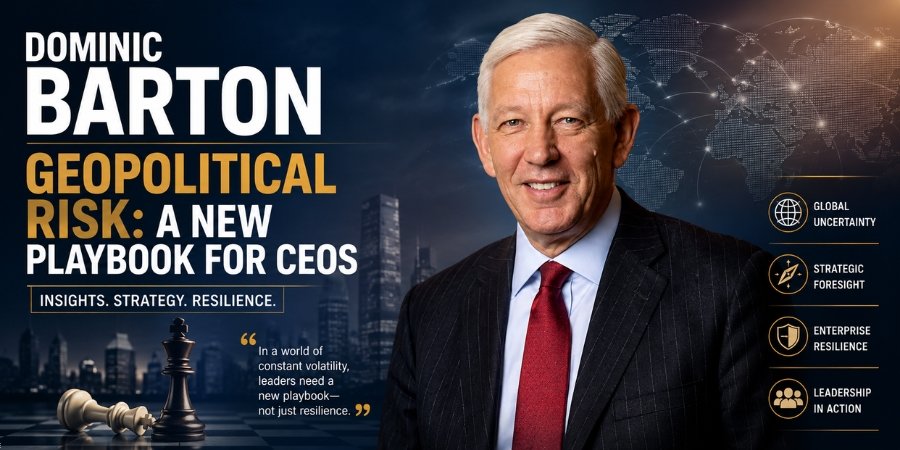
Dominic Barton geopolitical risk concerns are moving closer to the center of corporate decision-making, according to Barton, strategic counselor to Eurasia Group and chairman of Rio Tinto. Speaking with Fortune on August 19, 2026, Barton argued that companies can no longer treat geopolitics as an occasional boardroom discussion as tariffs, wars, technology restrictions and supply-chain pressures increasingly affect business decisions.
Barton said the assumptions that once shaped international business—including free trade, international institutions and a rules-based global order—are changing. His message to executives was direct: geopolitical considerations need to become part of how companies assess finances, operations, technology, data and government relationships.
Why Dominic Barton says geopolitical risk can no longer sit on the sidelines
Barton criticized the traditional approach in which companies occasionally invite a former politician or other experienced figure to speak about international affairs at a corporate dinner.
“You have to move away from the after-dinner speaker,” Barton told Fortune, arguing that this model is no longer sufficient for businesses operating in a more uncertain environment.
His broader argument is that Dominic Barton geopolitical risk thinking should be integrated into everyday corporate strategy rather than treated as a separate issue handled by specialists.
That means executives must consider questions such as how much debt a company can carry, whether its balance sheet can withstand disruptions, how secure its supply chains are, where its data is managed and where the company is incorporated.
Tariffs and shifting international relations raise the stakes
Barton spoke to Fortune after U.S. President Donald Trump imposed 50% tariffs on some Canadian goods, including automobiles, dairy products and alcohol. Trump had also threatened tariffs connected to wildfire smoke crossing the U.S.-Canada border.
Barton contrasted the current environment with the way diplomatic issues were handled in the past.
“Fifteen years ago, there would have probably been diplomats bringing this forward. Now it’s just tweeted,” he said.
The situation remained fluid on August 19, when Trump announced on social media that the new Canada tariffs would be delayed by three days as the two countries moved toward a deal, according to the Fortune report.
For Barton, that volatility reinforces the need for businesses to prepare for changing political conditions rather than rely on assumptions about how global commerce operated in the past.
Barton’s experience shapes his warning to executives
Barton brings experience from business, diplomacy and corporate leadership to the discussion. He spent decades at McKinsey and eventually led the firm’s Asia business before entering government.
In 2019, Canadian Prime Minister Justin Trudeau appointed Barton as Canada’s ambassador to China. During his diplomatic posting, Barton was involved in the period surrounding the detention of Canadian citizens Michael Kovrig and Michael Spavor by China. The two men were released in 2021 after the United States agreed to defer prosecution of Huawei chief financial officer Meng Wanzhou.
Barton now serves as chairman of Rio Tinto while also working as a strategic counselor to Eurasia Group. That combination gives his Dominic Barton geopolitical risk warning a direct connection to both international affairs and corporate operations.
CEOs may need stronger government relationships
Barton said senior executives will increasingly need to spend more time understanding governments and developing government-relations capabilities.
He cited Temasek CEO Dilhan Pillay Sandrasegara, former Apple CEO Tim Cook and Tesla CEO Elon Musk as examples of business leaders who have developed greater familiarity with how foreign governments operate.
His point extends beyond diplomacy. Barton said geopolitical exposure can affect fundamental corporate decisions, including supply-chain security, data management, financing and corporate location.
That makes Dominic Barton geopolitical risk advice relevant not only to companies with large international operations but also to executives making long-term decisions about where and how their businesses operate.
Rio Tinto’s experience highlights China’s changing role
Barton also discussed how China’s emergence as a technological power is influencing Rio Tinto’s operations.
He described China as both a competitor and a significant source of intellectual property. Barton said Rio Tinto’s purchasing from China has increased substantially, even though some Chinese products cost more than traditional Western alternatives. He said the products can be better and more durable.
Barton declined to discuss Rio Tinto’s business in significant detail, referring to the company’s July 29 earnings release. The company subsequently reported a 43% increase in underlying earnings for the first half of the year, citing higher copper and aluminum prices and demand associated with data centers.
Barton summarized the broader environment as carrying both greater risk and greater opportunity. His assessment of Dominic Barton geopolitical risk is that companies should stop waiting for international conditions to return to an earlier model and instead build geopolitical awareness directly into corporate strategy.
This news has been compiled using information gathered from various platforms and is intended for general informational purposes only.