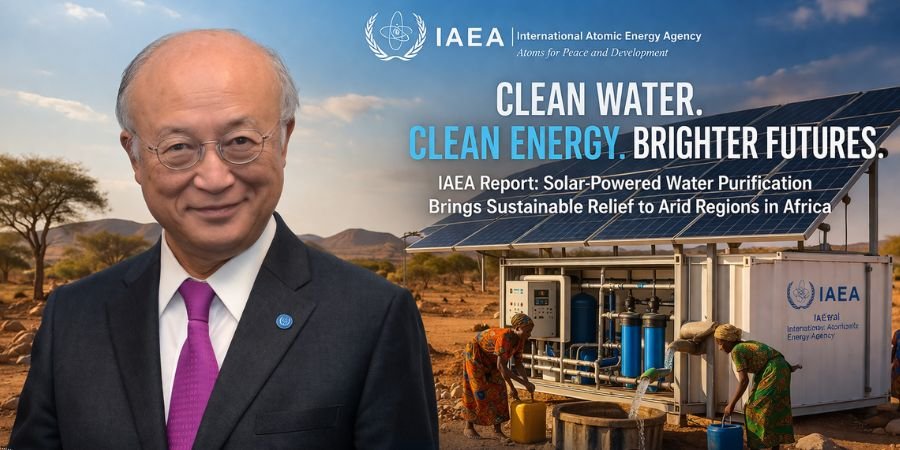
The International Atomic Energy Agency (IAEA) released a landmark report detailing the successful deployment of solar-powered water purification systems across arid regions of Africa. The initiative, supported by international cooperation and overseen by leadership linked to Yukiya Amano, marks a major step toward addressing water scarcity using clean, renewable energy.
The report confirms that these systems are now providing reliable access to safe drinking water in multiple drought-prone communities. By harnessing solar energy, the technology eliminates dependence on fossil fuels while ensuring continuous operation even in remote areas.
A Sustainable Solution to Water Scarcity
The IAEA report highlights how solar-powered purification units are transforming water access in regions where traditional infrastructure is limited. These systems use solar panels to power filtration processes, making them both cost-effective and environmentally sustainable.
Communities that previously relied on contaminated or distant water sources are now benefiting from clean, locally available water. This has led to improvements in public health, reduced waterborne diseases, and enhanced quality of life.
Why the IAEA Report Is Trending
The global attention surrounding this IAEA report stems from its potential to address one of the most pressing challenges of our time—the global water crisis. With climate change intensifying drought conditions in many parts of the world, sustainable solutions are urgently needed.
What makes this development particularly significant is its scalability. The solar-powered systems can be deployed in other regions facing similar challenges, making it a replicable model for global impact.
Innovation Without Fossil Fuels
A key highlight of the initiative is its complete reliance on renewable energy. Unlike conventional water treatment systems that depend on electricity generated from fossil fuels, these units operate entirely on solar power.
This approach not only reduces carbon emissions but also ensures long-term affordability. Maintenance costs are lower, and communities are less vulnerable to energy price fluctuations, making the solution both environmentally and economically viable.
The Role of Global Collaboration
The success of this project underscores the importance of international collaboration in tackling humanitarian challenges. The IAEA worked closely with local governments, scientists, and development agencies to implement and monitor the systems.
Leadership associated with figures like Yukiya Amano has played a crucial role in promoting the peaceful and practical applications of nuclear and related technologies, including water resource management.
What Comes Next
Following the success outlined in the IAEA report, further expansion of solar-powered water purification systems is expected across other water-stressed regions worldwide. As governments and organizations look for sustainable solutions, this breakthrough could serve as a blueprint for future initiatives aimed at securing clean water for all.