
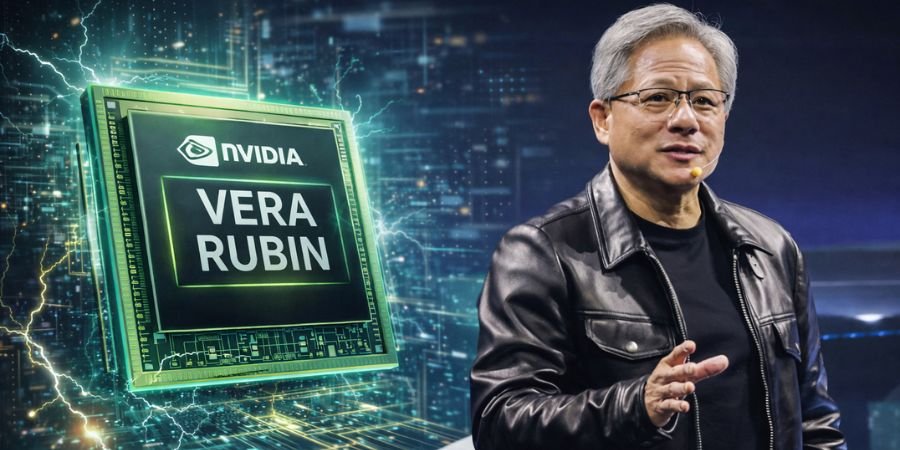
Jensen Huang, CEO of NVIDIA, became the world’s top-trending technology leader today after delivering a major keynote at SAP Center during NVIDIA GTC 2026. The announcement of the new “Vera Rubin” chip architecture—designed to reduce energy consumption in AI training by up to 80%—has triggered widespread attention across the global tech industry and financial markets.
The breakthrough announcement comes at a time when artificial intelligence infrastructure demand is accelerating worldwide. Huang also made a bold declaration during the keynote, stating that AI has now become a “utility,” similar to electricity or the internet, signaling a new phase in how companies and governments will consume computing power.
Vera Rubin Architecture Promises Massive Energy Efficiency
During the presentation, Jensen Huang introduced Vera Rubin, NVIDIA’s next-generation AI computing architecture. The system is designed specifically to address the growing energy demands of large-scale AI models and data center training workloads.
According to Huang, the new architecture can reduce energy consumption by roughly 80% compared to previous AI training systems, while maintaining high performance levels required for next-generation models.
The announcement is particularly significant as global AI expansion has raised concerns about data center power usage, sustainability, and infrastructure costs. By improving energy efficiency, the Vera Rubin platform could help organizations scale AI deployment while lowering operational expenses.
Industry analysts say this innovation may reshape how hyperscale cloud providers, enterprises, and research labs build AI systems over the next decade.
Jensen Huang Declares AI Is Now a “Utility”
One of the most widely shared moments from Jensen Huang’s keynote came when he described artificial intelligence as the next fundamental global infrastructure layer.
Huang stated that AI should now be viewed as a utility—like electricity, water, or internet connectivity. This concept suggests that AI computing will become a universally accessible resource powering industries from healthcare and finance to manufacturing and education.
The statement quickly went viral across technology and financial media, reinforcing the idea that AI infrastructure providers could become as essential as traditional energy companies in the digital economy.
Semiconductor Stocks Surge After the Announcement
Following Jensen Huang’s keynote, semiconductor and AI infrastructure stocks rallied sharply in global markets. Investors interpreted the Vera Rubin announcement as a signal that AI demand—and the hardware supporting it—will continue expanding rapidly.
NVIDIA’s position as a dominant supplier of AI accelerators has already made the company one of the most valuable technology firms in the world. The introduction of a significantly more energy-efficient architecture strengthens its leadership in the AI hardware race.
Market analysts noted that the announcement could benefit a broader ecosystem of semiconductor companies involved in AI chips, advanced packaging, and data center infrastructure.
Why Jensen Huang Is Trending Worldwide Today
Several factors explain why Jensen Huang became the most talked-about technology executive today:
-
The unveiling of the Vera Rubin AI chip architecture
-
A bold prediction that AI is now a global utility
-
The promise of 80% lower energy usage for AI training
-
Immediate financial market reactions and semiconductor stock rallies
Technology conferences often produce important announcements, but the scale of the Vera Rubin innovation and Huang’s strategic vision for AI infrastructure pushed the keynote into global headlines.
What Comes Next for NVIDIA and AI Infrastructure
The Vera Rubin architecture is expected to shape the next generation of AI supercomputing platforms once it moves from announcement to full commercial deployment. Major cloud providers and enterprise technology firms will likely evaluate the new architecture for large-scale AI training environments.
If the promised efficiency gains materialize, Jensen Huang’s latest announcement could accelerate the expansion of AI infrastructure worldwide while easing concerns about energy consumption.
Industry observers will now be watching closely to see when Vera Rubin systems reach production and how competitors respond in the rapidly evolving AI chip market.
Read Also: Brian Niccol’s ‘Back to Basics’ Plan Leads Starbucks 2026 Turnaround