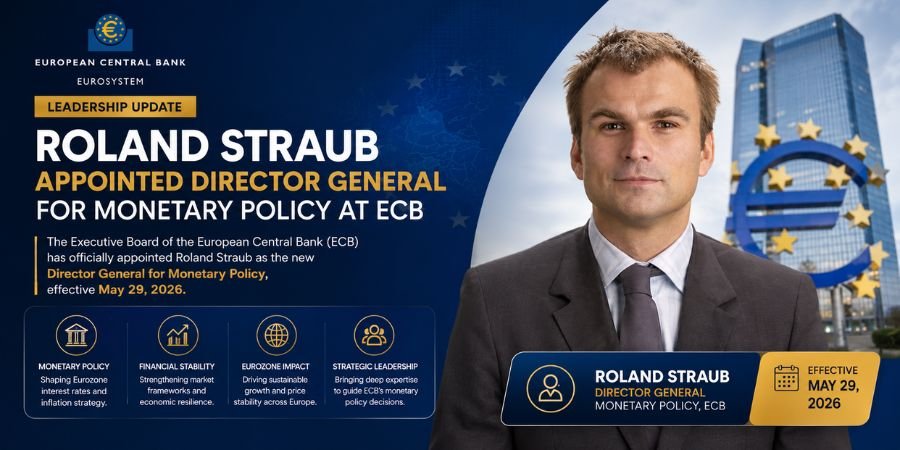
The Executive Board of the European Central Bank (ECB) has officially appointed Roland Straub as the new Director General for Monetary Policy, effective May 29, 2026. The appointment places Straub in one of the most influential financial leadership positions in Europe, where he will help shape Eurozone interest rates and oversee key central banking market frameworks.
The decision is already drawing significant attention across global financial markets, with economists, investors, and banking leaders closely watching how Roland Straub’s leadership could influence the future direction of the Eurozone economy. His role is expected to have a direct impact on inflation management, monetary stability, and broader European financial policy.
Why the Roland Straub ECB Appointment Is Trending
The appointment is trending because the Director General for Monetary Policy plays a central role in the ECB’s decision-making process during a period of ongoing economic uncertainty. With inflation pressures, fluctuating energy costs, and global market volatility continuing to affect European economies, leadership inside the ECB has become increasingly important.
Financial analysts believe Roland Straub’s strategic influence could shape future borrowing costs, banking liquidity measures, and monetary responses across the Eurozone. As a result, global investors and financial magnates are paying close attention to his next moves.
Roland Straub ECB Director General Monetary Policy Role Explained
As the new Director General for Monetary Policy, Roland Straub will be responsible for supporting the ECB’s monetary strategy and helping structure policies related to Eurozone interest rates. The role also involves overseeing operational frameworks tied to central banking markets and financial system stability.
The position carries substantial influence because ECB monetary policy decisions often affect international financial markets, currency strength, government bond yields, and corporate investment strategies. Market participants frequently monitor ECB leadership changes for signals regarding future policy direction.
Experts say Straub’s appointment comes at a critical time as European policymakers continue balancing economic growth concerns with inflation control measures. His experience and policy approach could therefore become a major factor in determining how aggressively the ECB acts in the coming months.
Global Markets React to ECB Leadership Shift
The announcement has generated immediate discussion among economists and institutional investors, many of whom see the leadership transition as a potentially important development for Europe’s financial outlook.
Several market observers believe the Roland Straub ECB Director General Monetary Policy appointment could influence future expectations around interest rate adjustments and financial market regulation. Investors are also watching for possible shifts in the ECB’s communication strategy and policy framework under his guidance.
The Eurozone remains under pressure from uneven economic growth across member states, making every senior ECB appointment highly significant for financial stability and investor confidence.
What Happens Next for the ECB?
With Roland Straub officially taking office on May 29, 2026, attention will now turn toward upcoming ECB policy meetings and future monetary signals. Analysts expect financial markets to closely monitor his early decisions, public statements, and policy priorities as the European Central Bank navigates a challenging economic environment.
His leadership could ultimately play a defining role in shaping the next phase of Eurozone monetary policy and determining how the ECB responds to evolving global financial conditions.
Also Read: Julie Sweet Accenture Enterprise AI Strategy Finalized for Global AI Rollout