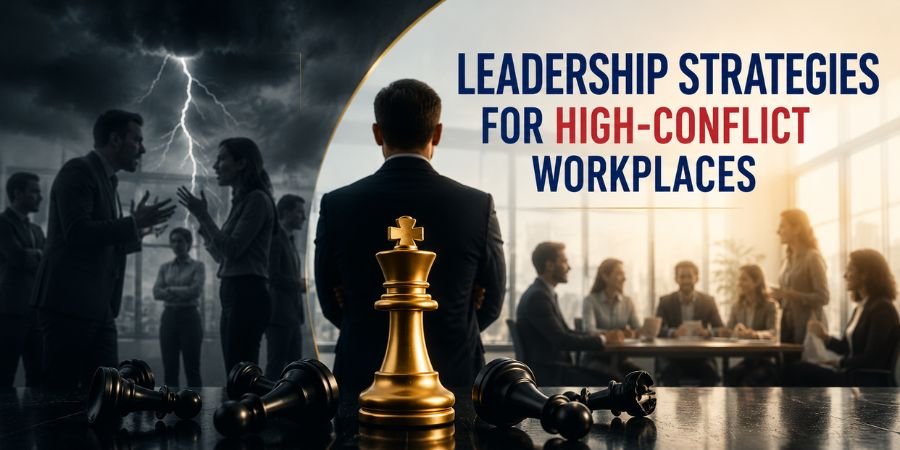
A product launch was delayed for the third time because two department heads refused to cooperate. Team meetings turned into silent battles, emails became passive-aggressive, and talented employees quietly started updating their resumes. Situations like this are becoming increasingly common across organizations of every size. Pressure, uncertainty, hybrid work models, and rising performance expectations have created environments where conflict spreads quickly if leadership is weak or inconsistent. The difference between a workplace that collapses under tension and one that grows stronger through challenges often comes down to one thing: leadership strategies for high-conflict workplaces. Strong leaders are no longer judged only by performance metrics or financial outcomes. They are evaluated by how effectively they manage friction, restore trust, and create emotional stability in environments where disagreement is unavoidable.
Understanding Why Workplace Conflict Is Intensifying in 2026
Conflict at work is not a new problem, but the nature of conflict has changed dramatically over the past few years. Organizations are now dealing with faster communication cycles, multicultural teams, remote collaboration, economic stress, and constant performance pressure. Employees are more vocal about expectations, boundaries, and fairness. At the same time, many managers were promoted because of technical skills rather than emotional intelligence.
This combination creates a dangerous environment where unresolved tension grows rapidly. Small misunderstandings can escalate into long-term resentment, damaged morale, and employee turnover. Leaders who fail to recognize these warning signs often assume productivity issues are related to skill gaps when the real issue is emotional instability within the team.
One of the most effective leadership strategies for high-conflict workplaces is recognizing that conflict itself is not always harmful. Healthy disagreement can encourage innovation, expose hidden problems, and improve decision-making. The real danger comes from unmanaged conflict that becomes personal, political, or emotionally destructive.
Common Causes of High-Conflict Workplaces
Several patterns repeatedly appear in organizations struggling with internal tension:
- Lack of communication clarity
- Poor accountability systems
- Favoritism from leadership
- Undefined job responsibilities
- Toxic competition between departments
- Emotional burnout
- Resistance to organizational change
- Weak conflict resolution skills among managers
- Cultural misunderstandings
- Fear-driven leadership styles
When these problems combine, teams begin operating defensively instead of collaboratively. Employees stop sharing ideas, avoid accountability, and protect themselves rather than supporting collective goals.
The Psychology Behind Workplace Conflict
To apply leadership strategies for high-conflict workplaces successfully, leaders must understand the psychology driving employee behavior. Most workplace conflict is not actually about the issue being discussed on the surface. It is often tied to deeper emotional triggers such as fear, insecurity, disrespect, loss of control, or lack of recognition.
For example, an employee arguing aggressively during meetings may not simply disagree with a strategy. They may feel ignored, undervalued, or threatened by organizational changes. Another employee avoiding communication might not be disengaged but emotionally exhausted after repeated unresolved tensions.
Great leaders look beyond visible behavior and identify underlying emotional drivers. This approach allows them to solve the real issue instead of repeatedly reacting to symptoms.
Emotional Safety Changes Everything
One of the strongest leadership strategies for high-conflict workplaces involves building psychological safety. Employees perform better when they feel safe expressing concerns without fear of humiliation or retaliation.
Psychological safety does not mean avoiding accountability or difficult conversations. It means creating an environment where disagreements are handled respectfully and professionally. When employees trust leadership to respond fairly, conflicts become easier to resolve before they escalate.
Leaders can strengthen emotional safety by:
- Encouraging respectful disagreement
- Listening without interrupting
- Avoiding public embarrassment
- Addressing issues privately when possible
- Rewarding collaboration instead of political behavior
- Admitting mistakes openly
- Maintaining consistency in decision-making
Teams that feel emotionally safe are more resilient during stressful periods because employees focus on solutions rather than self-protection.
How Leadership Style Influences Workplace Conflict
Leadership style has a direct impact on how conflict develops inside organizations. In many high-conflict environments, leadership behavior unintentionally fuels instability.
Micromanaging leaders often create frustration because employees feel distrusted. Highly passive leaders allow toxic behavior to continue unchecked. Aggressive leaders increase fear and defensiveness. Inconsistent leaders create confusion and resentment.
Effective leadership strategies for high-conflict workplaces require balance. Leaders must remain calm under pressure while also being decisive and accountable.
Authoritative Leadership vs Authoritarian Leadership
Many organizations confuse authority with control. Authoritative leadership provides direction, clarity, and confidence while still respecting employee input. Authoritarian leadership relies on fear, rigid control, and emotional intimidation.
Employees may temporarily comply with authoritarian leadership, but long-term results are usually damaging. Creativity declines, trust disappears, and conflict becomes hidden instead of resolved.
Authoritative leaders create structure while maintaining emotional intelligence. They set clear expectations but also encourage communication and collaboration.
Transformational Leadership in Conflict Environments
Transformational leadership is especially effective in tense workplaces because it focuses on motivation, shared purpose, and trust-building. Instead of controlling employees through fear, transformational leaders inspire commitment through vision and transparency.
Key behaviors include:
- Communicating a clear organizational purpose
- Recognizing employee contributions
- Encouraging personal growth
- Leading by example
- Addressing problems directly and respectfully
- Creating unity across departments
This leadership style reduces political behavior because employees feel connected to broader organizational goals.
Communication Strategies That Reduce Conflict
Communication problems are responsible for a significant percentage of workplace tension. Misunderstood expectations, unclear feedback, delayed responses, and emotionally charged messaging can quickly damage team relationships.
One of the most practical leadership strategies for high-conflict workplaces is improving communication systems before conflicts become severe.
Active Listening Is a Leadership Skill
Many leaders believe they are listening when they are actually preparing responses. Employees recognize this immediately. When people feel unheard, frustration grows rapidly.
Active listening involves giving full attention, asking clarifying questions, and reflecting understanding before responding. This approach lowers emotional intensity because employees feel respected.
A leader practicing active listening might say:
- “Help me understand your concern more clearly.”
- “What outcome are you hoping for?”
- “It sounds like you feel excluded from the decision-making process.”
- “What do you think would improve this situation?”
These responses invite collaboration rather than defensiveness.
Replace Emotional Reactions With Structured Conversations
High-conflict workplaces often normalize emotionally reactive communication. Leaders who respond impulsively increase instability.
Structured conversations are far more effective. This means separating facts from emotions, focusing on behaviors rather than personalities, and maintaining calm body language.
For example, instead of saying:
“You always create problems during meetings.”
A stronger leadership approach would be:
“I noticed several interruptions during today’s meeting, and it prevented the team from completing the discussion effectively.”
This subtle shift prevents personal attacks and keeps conversations solution-focused.
Transparency Builds Trust
Employees become anxious when leadership withholds information during uncertain periods. Lack of transparency creates rumors, suspicion, and unnecessary conflict.
Strong leaders communicate clearly about:
- Organizational changes
- Performance expectations
- Team restructuring
- Business challenges
- Decision-making processes
- Conflict resolution procedures
Transparency does not mean sharing every detail. It means reducing uncertainty whenever possible.
Leadership Strategies for High-Conflict Workplaces During Organizational Change
Workplace conflict often increases during periods of transition. Mergers, restructuring, layoffs, technology adoption, and leadership changes create emotional stress that impacts behavior.
Employees experiencing uncertainty may become defensive, resistant, or emotionally reactive. Departments may compete for resources, recognition, or influence.
This is why leadership strategies for high-conflict workplaces must adapt during organizational change.
Acknowledge Emotional Resistance
One of the biggest mistakes leaders make is dismissing employee emotions during change initiatives. Employees who feel ignored are more likely to resist openly or disengage silently.
Effective leaders acknowledge uncertainty honestly. They understand that resistance is often rooted in fear rather than negativity.
Helpful leadership responses include:
- “I understand this transition feels uncertain.”
- “Many people are adjusting to these changes differently.”
- “We may not have every answer immediately, but communication will remain open.”
This approach reduces emotional escalation because employees feel recognized instead of dismissed.
Keep Decision-Making Consistent
In unstable environments, inconsistency damages credibility quickly. If leadership applies rules unevenly or changes expectations constantly, employees lose trust.
Consistency is one of the most overlooked leadership strategies for high-conflict workplaces. Employees may disagree with decisions, but predictable leadership still creates stability.
Leaders should ensure:
- Policies are applied equally
- Feedback standards remain consistent
- Accountability systems are fair
- Communication is regular
- Expectations are clearly documented
Consistency reduces confusion, favoritism accusations, and internal politics.
Building Trust in High-Conflict Teams
Trust is fragile in workplaces experiencing prolonged tension. Once employees begin assuming negative intent from colleagues or leadership, collaboration becomes extremely difficult.
Rebuilding trust requires intentional effort and long-term consistency.
Trust Is Built Through Small Actions
Leaders often underestimate how quickly trust erodes through small behaviors such as ignored emails, broken promises, delayed follow-ups, or inconsistent feedback.
Similarly, trust is rebuilt through repeated small actions:
- Following through on commitments
- Respecting confidentiality
- Giving credit fairly
- Addressing concerns promptly
- Remaining calm during pressure
- Treating all employees respectfully
Employees observe leadership behavior constantly. Culture is shaped more by consistent actions than motivational speeches.
Encourage Cross-Team Collaboration
Departmental conflict is common in large organizations. Sales blames operations, operations blames management, and management blames communication gaps.
One of the most practical leadership strategies for high-conflict workplaces is creating opportunities for cross-functional collaboration.
Leaders can:
- Organize shared projects
- Create mixed-department problem-solving groups
- Rotate responsibilities temporarily
- Encourage mentorship across teams
- Hold collaborative planning sessions
When employees understand each other’s pressures and responsibilities, empathy increases and hostility decreases.
Conflict Resolution Techniques Every Leader Needs
Avoiding conflict rarely solves anything. In fact, unresolved tension usually becomes more emotionally charged over time.
Strong leaders address conflict early while emotions are still manageable.
Focus on Interests, Not Positions
People often argue aggressively about positions while ignoring shared interests.
For example:
- One manager demands more staff.
- Another refuses because of budget restrictions.
The deeper shared interest may actually be improving customer service quality.
Leadership strategies for high-conflict workplaces become more effective when leaders identify common goals hidden beneath disagreement.
Use Mediation When Necessary
Some conflicts become too emotionally complex for direct resolution. In these situations, mediation can help create structured communication.
A skilled mediator:
- Allows both parties to speak openly
- Clarifies misunderstandings
- Redirects emotional escalation
- Encourages solution-focused dialogue
- Creates accountability agreements
Leaders should never allow personal hostility to continue indefinitely simply because conversations feel uncomfortable.
Set Behavioral Boundaries
Healthy workplaces allow disagreement but do not tolerate abusive behavior.
Leaders must establish clear behavioral expectations regarding:
- Respectful communication
- Meeting conduct
- Harassment policies
- Professional accountability
- Email etiquette
- Collaboration standards
Without boundaries, toxic behavior becomes normalized.
Emotional Intelligence as a Leadership Advantage
Technical expertise alone is no longer enough to lead effectively. Emotional intelligence has become one of the most valuable leadership skills in high-pressure environments.
Emotional intelligence includes:
- Self-awareness
- Emotional regulation
- Empathy
- Social awareness
- Relationship management
Leaders with strong emotional intelligence recognize tension early and respond constructively.
Self-Regulation Prevents Escalation
Employees mirror leadership behavior. If leaders panic, react aggressively, or become emotionally unpredictable, teams absorb that instability.
One of the most effective leadership strategies for high-conflict workplaces is emotional self-regulation.
This includes:
- Pausing before responding emotionally
- Maintaining calm body language
- Avoiding public confrontations
- Separating personal frustration from professional decisions
- Staying composed during criticism
Calm leadership creates psychological stability during stressful situations.
Empathy Improves Accountability
Some leaders fear empathy weakens authority. In reality, empathy strengthens accountability because employees are more willing to cooperate with leaders they trust.
Empathy does not mean avoiding difficult decisions. It means understanding employee perspectives while still maintaining standards.
A leader can be both compassionate and accountable at the same time.
How Remote and Hybrid Workplaces Increase Conflict
Remote work has created new communication challenges. Without face-to-face interaction, misunderstandings occur more easily. Tone is often misinterpreted through email or messaging platforms.
Hybrid teams may also develop resentment when remote employees feel excluded or office-based employees feel overburdened.
Leadership strategies for high-conflict workplaces must now include digital communication management.
Prevent Digital Miscommunication
Leaders should encourage communication habits that reduce confusion:
- Use video calls for sensitive discussions
- Avoid emotionally charged email exchanges
- Clarify responsibilities in writing
- Summarize key meeting decisions
- Encourage direct communication instead of gossip
Digital communication requires greater intentionality because nonverbal context is limited.
Maintain Inclusion Across Work Models
Hybrid work environments can unintentionally create divisions between remote and in-office employees.
Strong leaders ensure:
- Equal access to information
- Fair recognition opportunities
- Balanced workload distribution
- Inclusive meeting practices
- Consistent performance standards
Employees who feel excluded are more likely to disengage or develop resentment.
Preventing Burnout in High-Conflict Environments
Burnout and conflict are closely connected. Emotionally exhausted employees become less patient, more reactive, and less collaborative.
Many organizations mistakenly treat burnout as an individual weakness instead of a leadership issue.
Recognize Early Burnout Signals
Leaders should watch for:
- Increased irritability
- Withdrawal from teamwork
- Declining motivation
- Frequent absenteeism
- Reduced communication
- Emotional exhaustion
- Cynicism toward leadership
Ignoring these signs often leads to worsening workplace conflict.
Create Sustainable Performance Expectations
One of the smartest leadership strategies for high-conflict workplaces is balancing performance pressure with sustainable work systems.
This includes:
- Realistic deadlines
- Clear prioritization
- Encouraging recovery time
- Preventing unnecessary overtime
- Supporting mental well-being
- Reducing chaotic workflow systems
Employees perform better when they are mentally and emotionally stable.
Accountability Without Fear
Some leaders believe fear improves discipline. While fear may create temporary compliance, it damages long-term trust and innovation.
Employees operating in fear-based environments often:
- Hide mistakes
- Avoid communication
- Resist feedback
- Blame others
- Protect themselves politically
Healthy accountability systems focus on improvement rather than humiliation.
Separate Accountability From Punishment
Effective leadership strategies for high-conflict workplaces involve correcting problems while maintaining dignity.
Instead of publicly criticizing employees, strong leaders:
- Address issues privately
- Focus on specific behaviors
- Clarify expectations
- Offer support when needed
- Create improvement plans
This approach maintains professionalism while still reinforcing standards.
Encourage Ownership
Employees are more likely to take responsibility when they feel trusted.
Leaders can encourage ownership by:
- Involving employees in decision-making
- Asking for solutions, not just complaints
- Recognizing initiative
- Delegating meaningful responsibility
- Supporting professional development
Ownership increases engagement and reduces defensive workplace behavior.
The Role of Culture in Conflict Management
Workplace culture determines how conflict is handled daily. Some cultures encourage transparency and collaboration. Others reward politics, silence, or competition.
Leadership strategies for high-conflict workplaces fail when organizational culture contradicts leadership messaging.
For example, a company cannot claim to value teamwork while rewarding only individual competition.
Build a Culture of Respect
Respect should not depend on hierarchy. Employees notice quickly when leaders tolerate disrespect from high performers while disciplining others.
Respect-based cultures prioritize:
- Professional communication
- Equal treatment
- Recognition fairness
- Constructive feedback
- Inclusive collaboration
- Ethical leadership behavior
Culture becomes stronger when leaders model the behavior they expect.
Reward Collaborative Behavior
Organizations often unintentionally reward conflict by celebrating aggressive competition.
Leaders should recognize:
- Team collaboration
- Mentorship
- Problem-solving
- Emotional intelligence
- Conflict resolution contributions
- Knowledge sharing
Employees adapt behavior based on what leadership consistently rewards.
Leadership Strategies for High-Conflict Workplaces in Diverse Teams
Modern workplaces are increasingly diverse across cultures, communication styles, generations, and professional backgrounds. Diversity strengthens innovation but can also create misunderstandings when leaders fail to manage differences effectively.
Understand Communication Differences
Some employees communicate directly while others prioritize diplomacy and relationship-building. Misunderstandings occur when leaders interpret these differences negatively.
Strong leaders avoid assumptions and encourage respectful clarification.
Helpful questions include:
- “Can you explain your perspective further?”
- “How do you prefer to receive feedback?”
- “What communication approach works best for your team?”
Curiosity reduces unnecessary tension.
Create Inclusive Decision-Making
Employees are less likely to become resistant when they feel included in discussions affecting their work.
Inclusive leadership strategies for high-conflict workplaces involve:
- Encouraging multiple perspectives
- Avoiding favoritism
- Rotating leadership opportunities
- Inviting quieter voices into conversations
- Ensuring meetings are balanced
Inclusion strengthens trust and reduces internal division.
Practical Leadership Habits That Reduce Conflict Daily
Large organizational transformations matter, but daily leadership habits often have the greatest impact on workplace tension.
Small interactions shape culture consistently.
Daily Habits Strong Leaders Practice
Effective leaders in high-conflict environments often:
- Begin meetings with clarity
- Address misunderstandings early
- Maintain emotional consistency
- Recognize employee contributions regularly
- Follow through on commitments
- Encourage respectful debate
- Avoid gossip and political behavior
- Stay accessible during stressful periods
These behaviors create emotional predictability, which reduces workplace anxiety.
Avoid Leadership Blind Spots
Some leaders unintentionally contribute to conflict without realizing it.
Common leadership blind spots include:
- Interrupting employees frequently
- Showing visible favoritism
- Avoiding difficult conversations
- Overreacting emotionally
- Communicating inconsistently
- Ignoring team morale
- Rewarding toxic high performers
Self-awareness is essential for long-term leadership effectiveness.
Measuring Success in Conflict Management
Many organizations only measure productivity, sales, or financial performance. However, workplace stability should also be evaluated.
Leaders should monitor:
- Employee turnover rates
- Internal complaints
- Team collaboration quality
- Engagement surveys
- Absenteeism patterns
- Retention of high performers
- Cross-department cooperation
Strong leadership strategies for high-conflict workplaces create measurable improvements in both morale and performance.
Conflict Reduction Improves Business Results
Organizations with healthier internal dynamics often experience:
- Higher productivity
- Better innovation
- Faster decision-making
- Lower turnover costs
- Stronger customer service
- Greater employee loyalty
- Improved employer reputation
Conflict management is not separate from business success. It directly influences operational performance.
Mistakes Leaders Must Avoid in High-Conflict Workplaces
Even experienced leaders can worsen workplace tension through avoidable mistakes.
Ignoring Small Problems
Minor tensions rarely disappear on their own. Avoidance usually allows resentment to grow.
Taking Sides Too Quickly
Employees lose trust when leaders appear biased before understanding the full situation.
Public Criticism
Embarrassing employees publicly damages morale and increases defensiveness.
Inconsistent Standards
Applying rules unevenly creates resentment and political behavior.
Prioritizing Productivity Over People
Short-term output may improve temporarily, but long-term culture deteriorates.
Avoiding these mistakes is just as important as implementing positive leadership behaviors.
Future Trends Shaping Workplace Conflict in 2026
Leadership expectations are continuing to evolve rapidly. Organizations can no longer rely on outdated management approaches focused purely on authority and control.
Several trends are reshaping leadership strategies for high-conflict workplaces:
Greater Focus on Mental Health
Employees increasingly expect organizations to support emotional well-being, not just productivity.
AI and Technology Disruption
Automation anxiety and changing job roles may increase workplace tension if communication is poor.
Cross-Generational Teams
Different generations often have varying communication styles, career expectations, and workplace values.
Increased Demand for Transparency
Employees expect honesty, ethical leadership, and accountability from management.
Leaders who adapt to these changes will build stronger, more resilient organizations.
How Leaders Can Build Long-Term Stability
High-conflict workplaces rarely improve through temporary motivational campaigns or isolated training sessions. Real change requires consistent leadership behavior over time.
Long-term stability is built when leaders:
- Communicate transparently
- Maintain fairness consistently
- Address conflict early
- Encourage collaboration
- Develop emotional intelligence
- Protect psychological safety
- Model respectful behavior
- Prioritize sustainable performance systems
Employees remember how leadership behaves during difficult moments more than during successful periods.
Organizations that invest in healthy leadership practices create environments where employees feel respected, motivated, and emotionally secure.
FAQs
Why are leadership strategies for high-conflict workplaces important?
Leadership strategies for high-conflict workplaces help organizations reduce tension, improve communication, strengthen employee trust, and maintain productivity during stressful situations. Without strong leadership, unresolved conflict can damage morale, increase turnover, and weaken collaboration.
How can leaders reduce workplace conflict quickly?
Leaders can reduce workplace conflict by improving communication, addressing issues early, encouraging active listening, setting clear expectations, and maintaining fairness consistently. Emotional intelligence and calm leadership behavior also play major roles.
What causes high-conflict workplaces?
High-conflict workplaces are often caused by unclear communication, poor leadership, favoritism, burnout, lack of accountability, organizational change, toxic competition, and unresolved emotional tension between employees or departments.
When should leaders intervene in workplace conflict?
Leaders should intervene as early as possible. Waiting too long allows resentment to grow and makes conflict harder to resolve. Early intervention prevents emotional escalation and protects team relationships.
How does emotional intelligence help in conflict management?
Emotional intelligence helps leaders remain calm under pressure, understand employee emotions, communicate effectively, and resolve disagreements constructively. It improves trust, collaboration, and overall workplace stability.
Conclusion
Pressure, uncertainty, and rapid organizational change have made conflict management one of the most valuable leadership skills in modern business. Teams no longer expect leaders to simply manage tasks and deadlines. They expect emotional stability, fairness, communication clarity, and the ability to navigate tension without creating fear or division.
The most effective leadership strategies for high-conflict workplaces focus on people as much as performance. Leaders who build trust, encourage respectful communication, maintain accountability fairly, and respond calmly during stressful situations create teams that are more resilient and collaborative. Conflict may never disappear completely from the workplace, but strong leadership determines whether conflict becomes destructive or transformative.
Organizations that invest in healthier leadership practices today will be far better prepared for the workplace challenges of 2026 and beyond. If your workplace is already experiencing tension, the best time to strengthen leadership habits is now rather than waiting for conflict to become part of the culture.
Also Read: What Is a Target Audience? Secrets Smart Brands Use to Grow in 2026