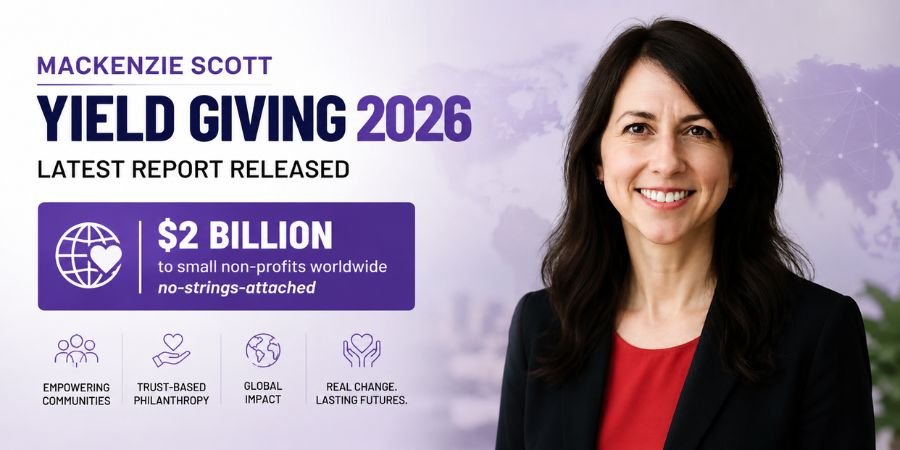
Philanthropist MacKenzie Scott has once again reshaped the global philanthropy landscape after releasing her latest Yield Giving report, announcing nearly $2 billion in donations to small non-profit organizations worldwide. The funding follows her signature “no-strings-attached” approach, allowing organizations to decide independently how the money should be used.
The announcement has quickly become one of the most discussed developments in global philanthropy and social impact circles. Experts say the latest MacKenzie Scott Yield Giving 2026 initiative could further pressure billionaires and major foundations to rethink traditional grant-making models that often involve lengthy approval processes and strict funding conditions.
Why MacKenzie Scott Yield Giving 2026 Is Trending
The latest Yield Giving report highlights Scott’s continued commitment to trust-based philanthropy. Instead of imposing operational restrictions, her donations are designed to give smaller organizations immediate financial flexibility.
Industry analysts believe this strategy is disrupting long-standing practices within charitable giving. Traditional philanthropy often requires extensive reporting, administrative oversight, and highly specific project-based funding. Scott’s model removes many of those barriers, enabling organizations to focus directly on community impact.
The MacKenzie Scott Yield Giving 2026 announcement is also trending because of the scale of the donations. Many of the recipient organizations are relatively small non-profits that historically struggled to secure large-scale global funding.
A Different Approach to Billionaire Philanthropy
Since becoming one of the world’s most influential philanthropists, Scott has built a reputation for rapid and unrestricted giving. Her Yield Giving platform continues to emphasize equity, community leadership, and operational trust.
Observers note that her methods differ sharply from more traditional philanthropic institutions, where funding decisions can take months or even years. Scott’s approach has inspired broader conversations about whether wealth-driven philanthropy should prioritize speed and autonomy over centralized oversight.
Supporters argue that unrestricted donations allow non-profits to invest in staffing, infrastructure, and long-term sustainability rather than focusing only on narrowly defined projects.
Global Non-Profits Receive Major Boost
According to the latest report, the new funding will support organizations across education, healthcare, poverty reduction, gender equality, and community development sectors. Several experts say the ripple effect could be significant, particularly for grassroots groups operating in underserved regions.
The MacKenzie Scott Yield Giving 2026 initiative arrives at a time when many charities are facing increasing operational costs, donor uncertainty, and rising global humanitarian challenges. For smaller organizations, unrestricted capital can often determine whether programs expand or shut down entirely.
The announcement has also fueled wider debates about accountability in philanthropy. While critics argue unrestricted giving may reduce oversight, supporters believe it demonstrates confidence in local leadership and community expertise.
How Yield Giving Could Influence Future Philanthropy
Scott’s continued high-profile giving is already influencing conversations among global business leaders, investors, and philanthropic advisors. Some analysts predict that more wealthy donors may begin adopting simplified grant-making models inspired by Yield Giving.
The growing visibility of the MacKenzie Scott Yield Giving 2026 report could also encourage non-profits to advocate for more flexible funding structures in the future. As economic uncertainty continues worldwide, trust-based philanthropy may become an increasingly influential trend across the charitable sector.
Looking ahead, many observers expect Scott’s giving strategy to continue shaping how modern philanthropy operates, potentially setting new standards for transparency, speed, and trust in large-scale global donations.
Also Read: Mark Zuckerberg Open-Source AI Vision Sparks Industry Shift