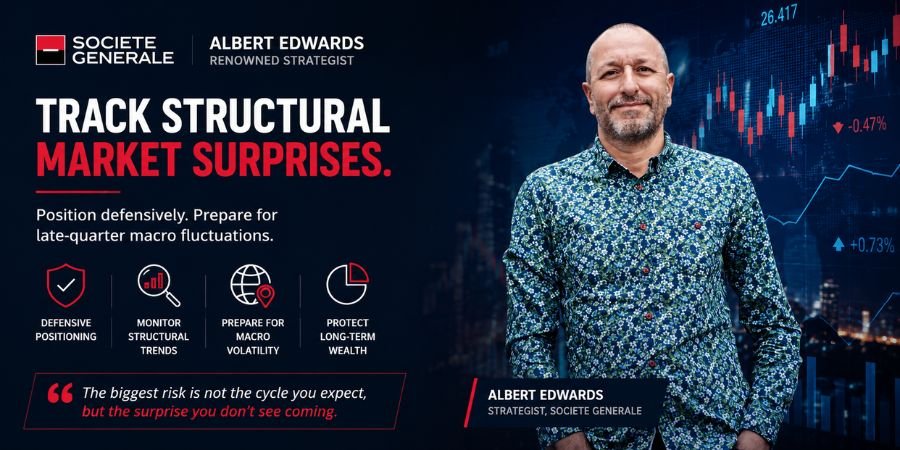
Veteran market strategist Albert Edwards has issued a fresh caution to institutional investors and global asset managers, urging them to monitor structural market surprises and adopt more defensive portfolio strategies amid rising macroeconomic uncertainty.
The latest Albert Edwards Structural Market Warning has quickly become a major discussion point across the financial sector, especially among hedge funds, wealth managers, and stock market strategists concerned about unpredictable late-quarter economic fluctuations.
Edwards, known for his long-standing bearish macroeconomic outlooks, emphasized that sudden shifts in liquidity conditions, interest rate expectations, and global growth forecasts could create sharp volatility across equities and fixed-income markets. His comments are being closely followed by institutions seeking protection from potential downside risks.
Why Albert Edwards’ Warning Is Trending
The Albert Edwards Structural Market Warning is trending because investors are increasingly worried about fragile market conditions heading into the next earnings and macroeconomic cycle. Persistent inflation concerns, shifting central bank policies, and geopolitical uncertainty have all contributed to growing caution among financial professionals.
Market participants are particularly focused on Edwards’ suggestion that structural surprises—not just short-term volatility—could reshape investor positioning over the coming quarters. Analysts say his remarks reflect broader concerns that markets may be underestimating macroeconomic stress signals.
Several institutional investors have reportedly begun reassessing exposure to risk-sensitive assets, including growth equities and highly leveraged sectors, following the renewed warning.
Defensive Positioning Gains Momentum
According to strategists monitoring institutional flows, defensive sectors such as utilities, healthcare, and consumer staples are once again attracting attention as investors seek stability. Asset managers are also reviewing allocations toward bonds, cash reserves, and alternative hedging strategies.
The Albert Edwards Structural Market Warning has reinforced the growing narrative that preserving capital may become more important than chasing aggressive returns during periods of economic instability.
Financial experts note that defensive positioning often becomes more prominent when late-quarter data surprises begin influencing broader market sentiment. This includes unexpected inflation readings, labor market changes, and revised GDP estimates.
Albert Edwards’ Reputation in Global Markets
Over the years, Societe Generale strategist Albert Edwards has built a reputation for issuing bold macroeconomic forecasts that frequently challenge mainstream market optimism. His previous warnings on asset bubbles, recession risks, and market corrections have made him one of the most closely watched voices in global finance.
While some investors view his outlooks as overly cautious, others believe his long-term perspective helps identify hidden systemic vulnerabilities before they become widely recognized.
The renewed attention around the Albert Edwards Structural Market Warning highlights how influential macro strategists continue to shape institutional sentiment during uncertain market periods.
What Investors Could Watch Next
Investors are now expected to closely monitor upcoming economic indicators, central bank commentary, and corporate earnings guidance for signs that could validate or challenge Edwards’ concerns. Market volatility, inflation trends, and liquidity conditions are likely to remain key focus areas in the weeks ahead.
If macroeconomic pressures continue to intensify, defensive investment strategies could gain even broader institutional support as markets prepare for the possibility of deeper structural shifts.
Also Read: Benjamin Aspir Named Among Global Top 200 Accounting Leaders